
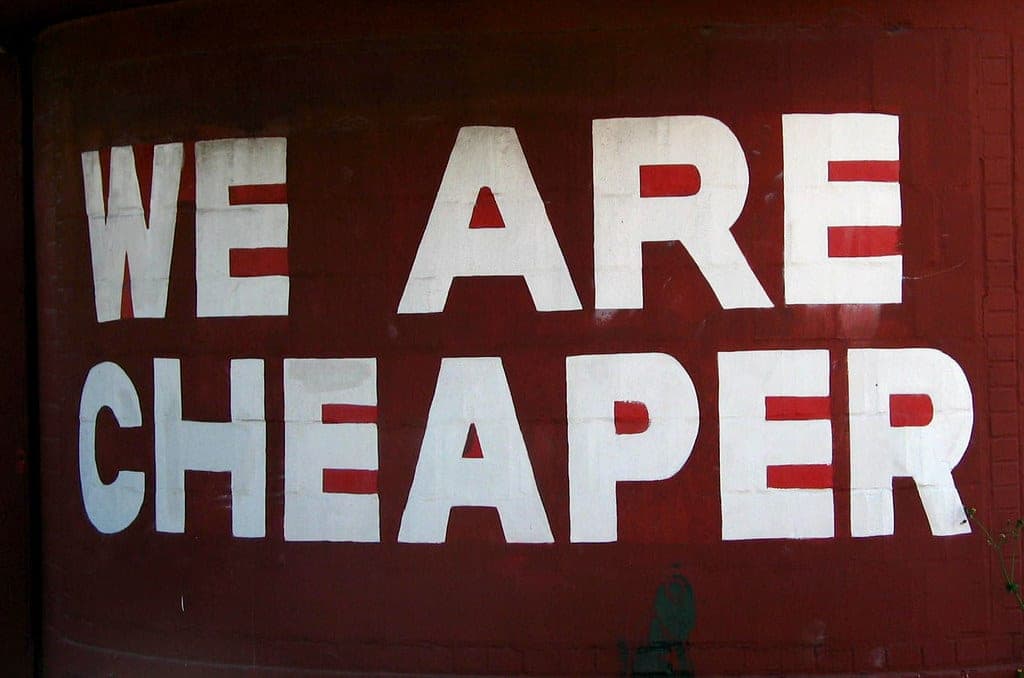
There's a guy who'll build your website for $300. There's an app that'll do it for $19 a month. There's your nephew, who's good with computers. I'm not going to tell you to never use any of them. I'm going to tell you what the cheap version actually costs, so the number you compare is the real one.
Cheap isn't a price, it's a deferral
A cheap website is rarely cheaper. It's the same cost, paid later, with interest, in a currency you didn't expect.
The $300 site costs you the three weekends you spend chasing the guy who's stopped answering. The $19-a-month builder costs you the afternoon a year for four years that you spend fighting the editor, plus $912 over those four years, plus the site the day you stop paying. The nephew costs you nothing until he moves, gets a real job, and takes the only login with him.
None of those costs show up on the invoice. All of them are real.
The three bills nobody quotes you
The findability bill. Cheap sites are usually slow and structureless. Slow, structureless sites don't rank. Not ranking means every customer who would have found you on Google instead found a competitor. You will never see this bill. It's the worst kind, because it's invisible and it compounds.
The trust bill. A site that looks thrown together tells a customer the work might be too. That's not fair to you — your work is probably excellent — but it's how people read it, and they read it in about two seconds. The cost is the quote that never gets requested.
The lock-in bill. This is the big one. Cheap usually means rented. The builder owns the platform; you own a monthly payment and a hostage situation. Stop paying and the site is gone, not yours to move, because you never had it. We wrote a whole piece on why website builders cost more, because this is where most of the money quietly goes.
What you're actually paying for at any price
Every website is the same four things: design, the code under it, the words on it, and the structure that makes Google understand it. Cheap doesn't remove any of those. It just moves who does them — onto you, onto an app, onto someone who'll vanish.
When we quote a one-time price, that's what the number covers: all four, done once, handed to you, yours to keep. No platform rent. The hosting is a few dollars a month paid to a host you control, not to us, and the site keeps working whether or not you ever talk to us again.
How to tell cheap from inexpensive
Inexpensive is fine. We start at $799 on purpose. The test isn't the number, it's three questions. Do you own the files and the domain outright when it's done? Does it still work if the person who built it disappears? Is there a monthly fee just to keep it online, or only for help you choose to buy?
A site can be inexpensive and pass all three. A cheap one fails at least one, usually quietly, usually about eighteen months in.
If you've got a cheap site now and you're not sure which bill you're paying, send us the URL. We'll tell you what we see, for free, before you spend anything fixing it.